In Conversation: Senior Leaders on the Current State of Customer Loyalty
ㅤ
We brought together senior leaders from some of the UK’s most renowned brands across switch-heavy industries at an exclusive roundtable hosted in partnership with the Data and Marketing Association (DMA) to discuss a pressing matter: the challenges of customer loyalty and what providers can do to combat the switching culture.
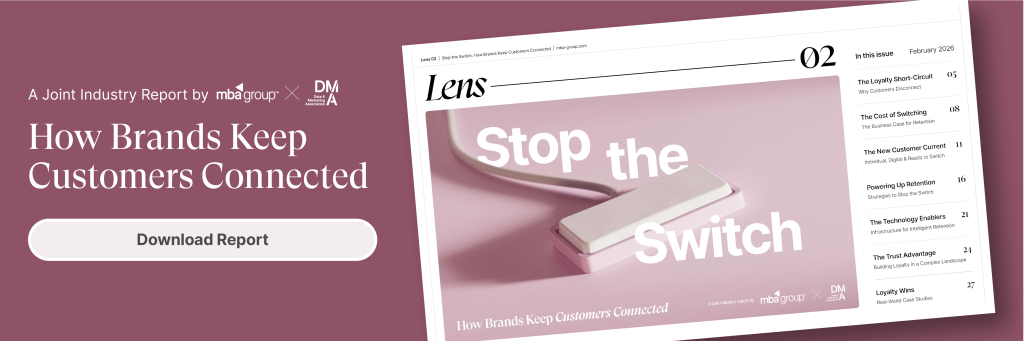
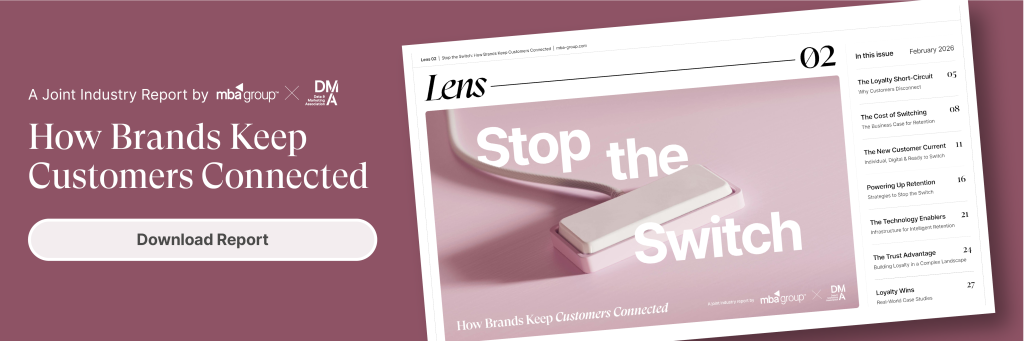
Stop the Switch: How Brands Keep Customers Connected is a joint industry report by MBA Group and the DMA covering why customers are disconnecting, the real financial cost of churn, and what the most effective retention strategies look like in practice.
Rather than basing the report solely on data and desk research, we wanted it to be informed by people working against these challenges day to day. The conversations were candid and honest, challenging each other’s assumptions and surfacing things that don’t always arise in formal research. Key quotes from the discussion are featured in the report, alongside analysis of over 1,700 data points from the DMA data bank including award-entered campaigns, survey responses and interviews.
ㅤ
If retention is on your agenda for 2026, download the report.
ㅤ
But first, here are the highlights from the roundtable.
ㅤ
The Damage of the Loyalty Penalty
Most people in the industry know the loyalty penalty exists. Rewarding new customers with better deals while existing ones quietly pay more has been a feature of utilities and telecoms pricing for years. What came through clearly in the room, though, was just how much damage this is doing to long-term trust, and how quickly it can end a relationship entirely.
“Finding out new customers are paying less than existing customers doesn’t just result in an ‘I’m not happy’ moment; it’s actually an ‘I’m never coming back’ type of moment — because the perception is: why is that person more valuable to you than me, when I’ve been with you for six years?”
– Ali Khan, Customer Analytics Advisor, Ex. WPP / Meta / Amazon
ㅤ
There’s a reason this point lands so hard. For a long-term customer, discovering they’re paying more than a new joiner feels like a direct message that their loyalty counts for nothing.
ㅤ
The Financial Case Against Churn
It’s well known that acquisition efforts costs businesses much more than retention does. But the leaders in the room wanted to go further and talk about how churn impacts a business over time.
“Every pound that you lose because of churn is almost two pounds you need to bring back in new business, just from a P&L perspective. Retention is absolutely the foundation of what we do.”
– Richard Robinson, General Manager, Insight by Confused.com
ㅤ
And the problem only gets harder the longer high churn continues.
“The bigger the churn gets, the bigger the true cost gets as well, because you essentially reduce your addressable market. There’s a confirmation bias that builds: ‘I tried them, I didn’t like them, I won’t go back.’ That voice is now much more visible than it was 10–15 years ago.”
– Michael Campbell, Marketing Director, So Energy
ㅤ
Reviews, social posts, conversations in group chats. A dissatisfied former customer has more reach now than ever. The cost of losing someone isn’t just the revenue line, it’s the conversations you’ll never see but that are absolutely happening behind your back.
ㅤ
Loyalty, or Inertia?
Probably the most honest thread running through the roundtable was that a lot of what brands call loyalty is actually inertia. Many customers who haven’t switched aren’t loyal in any meaningful sense, they just haven’t got round to it yet.
“We often see passive loyalty. Customers are loyal until something happens. It’s not an emotionally driven decision, it’s a condition-driven decision.”
– Richard Robinson, General Manager, Insight by Confused.com
ㅤ
The implication of this is uncomfortable but important. If customers are only staying because switching feels like hassle, then a single poor experience like a confusing bill, a price rise letter that lands badly, or a customer service call that goes nowhere, can be the thing that finally makes them switch. Years of adequate service won’t protect you from one bad moment if you haven’t built any real connection in between.
Which is why the leaders who are thinking about this well are focusing on the relationship before the ultimatum, not after it.
“If you understand your customers and what their next big investments are likely to be, you can start to nurture and bring them on that journey so that when the time comes for that big decision-making investment, they do it with you.”
– Michael Campbell, Marketing Director, So Energy
ㅤ
The Market Has Changed
Switching friction, one of the few structural reasons customers stayed put, has been deliberately removed with the introduction of One Touch Switch. For leaders already operating in an intensely competitive market, that change has raised the stakes even more.
“The telecoms sector was already an incredibly competitive one, with a wide range of products and deals available to the ultimate benefit of UK consumers. Now, following the introduction of One Touch Switch in our sector, it’s more important than ever for providers to adapt to keep meeting customers’ expectations.”
– Hannah Brown, Head of Customer Communications, Virgin Media O2
ㅤ
And in that environment, the temptation to compete on promotional offers is understandable, but the evidence suggests it doesn’t always work.
“When you’re trying to bring down churn, matching acquisition offers barely makes a dent. What matters is delivering on basic needs. Network quality, speeds, being able to call when you need to, access to data and transparency.”
– Sharad Malik, Customer Engagement and Loyalty, Lyca Mobile
ㅤ
Getting the fundamentals right before layering on loyalty programmes sounds obvious. In practice, plenty of businesses are still doing it the other way around.
ㅤ
Common Themes From the Room
- Fairness keeps coming back. Across almost every topic, the word that kept surfacing was fairness. Customers aren’t just comparing tariffs anymore, they’re forming a view about whether a provider is treating them reasonably. That perception is increasingly what drives the decision to stay or go.
- Demographic segmentation has had its day. The shift toward behavioural data was something multiple leaders raised, and Ali Khan put it most directly:
ㅤ
“Customer segmentation used to be done quite traditionally based on age and socio-economic factors. What we’ve seen in recent times is it’s gone very behavioural, based on what you’re doing and how you’re behaving. An 18-year-old might be behaving exactly the same as someone in the 45 age group in terms of tech usage, so putting them in separate segments makes absolutely no sense. Now they’ll get grouped together based on behaviour, spending patterns, and usage. We have some segments that have nothing to do with spend at all – they’re based purely on interest.”
– Ali Khan, Customer Analytics Advisor, Ex. WPP / Meta / Amazon
ㅤ
“Harnessing customer data gives brands a competitive edge, informing decisions from strategic direction through to campaign execution and measurement.”
– Ian Gibbs, Insight and Planning Director, DMA
ㅤ
- Retention belongs to the whole business. Marketing can’t solve churn on its own. When customer-facing teams are misaligned, when the brand promises something operations can’t deliver, or when complaints are handled in isolation from everything else, customers feel the disconnect and it shows up in their decision to leave.
ㅤ
Brand Substance Matters as Much as Brand Personality
A lot of the conversation, understandably, was about data, price and service. But one of the more interesting threads was about what brand identity actually does for retention, and where it falls short on its own.
“The major players have created strong brand identities from the beginning, different colours, distinct personalities, and customers became loyal to their choice. That mind share and consistent presence builds loyalty. But brands also need substance behind the personality: environmental commitments, ethical practices, what they truly stand for. Both layers matter.”
– Louise Winch, Head of Customer Communications and Marketing, TalkTalk
ㅤ
In a market where tariffs can look almost identical, a strong brand genuinely does help. But customers are increasingly good at spotting the gap between what a brand says it stands for and how it actually behaves. When that gap is visible, it becomes another reason to leave.
ㅤ
What It Adds Up To
Taken together, the roundtable pointed to churn that is largely preventable, driven by broken trust, passive loyalty that was never properly nurtured, and a persistent tendency to prioritise new customers over existing ones.
None of this is unfixable. But it does require businesses to take retention seriously as a strategic priority, with the data, the internal alignment, and the customer understanding to back it up, rather than treating it as something to address once acquisition starts to slow down.
ㅤ
This article draws on exclusive roundtable discussions hosted in partnership with the DMA, featuring senior leaders from across utilities, telecoms, and insurance.
ㅤ
For the full analysis, including case studies from O2, EE, Power NI, SMARTY and more, download Stop the Switch: How Brands Keep Customers Connected:
Stay Connected
Start innovating
Your contact details
